
Engineering

Applied to accelerometer data (or audio recordings) of rotating machinery, Sunics reveal aspects of the data which are hardly accessible via the time-waveform or spectrum. These include:

  • localization of faults in time and phase
  • slowly occuring changes (low frequency components)

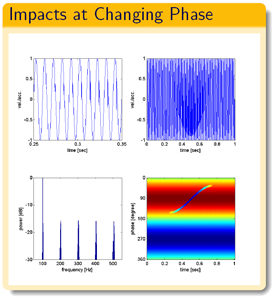
Example (simulated data): sunic (bottom right) clearly illustrates how a strong impact (blue curve) changes its phase (vertical axis) over time (horizontal axis). This is difficult to see in the time-waveform (top) and missing in the spectrum (bottom left).
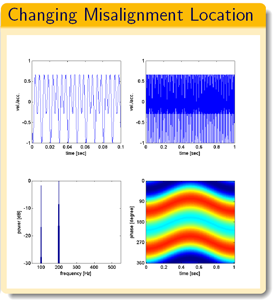
Example (simulated data): sunic (bottom right) clearly illustrates how the phase location of a misalignment slowly changes.


Sunics produce very detailed and distinctive patterns and thus allow a more detailed analysis of the vibration data than conventional methods.

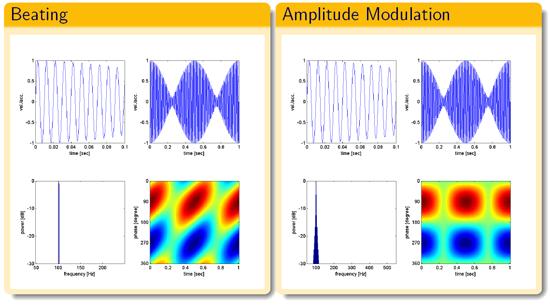
Example: simulated data for beating and amplitude modulations illustrate how sunics produce more distinctive patterns (bottom right) compared to spectrum (bottom left) and time-waveform (top).


More Information New Methods In Vibration Analysis (presentation held at VANZ 2006).

Vibration Analysis of Rotating Machinery

Applied to accelerometer data (or audio recordings) of rotating machinery, Sunics reveal aspects of the data which are hardly accessible via the time-waveform or spectrum. These include:

  • localization of faults in time and phase
  • slowly occuring changes (low frequency components)
Example (simulated data): sunic (bottom right) clearly illustrates how a strong impact (blue curve) changes its phase (vertical axis) over time (horizontal axis). This is difficult to see in the time-waveform (top) and missing in the spectrum (bottom left).
Example (simulated data): sunic (bottom right) clearly illustrates how the phase location of a misalignment slowly changes.


Read more ...
